B.Ed. Syllabus and Subjects Explained: Complete Semester-Wise Guide (2026)
 Aditya Sonker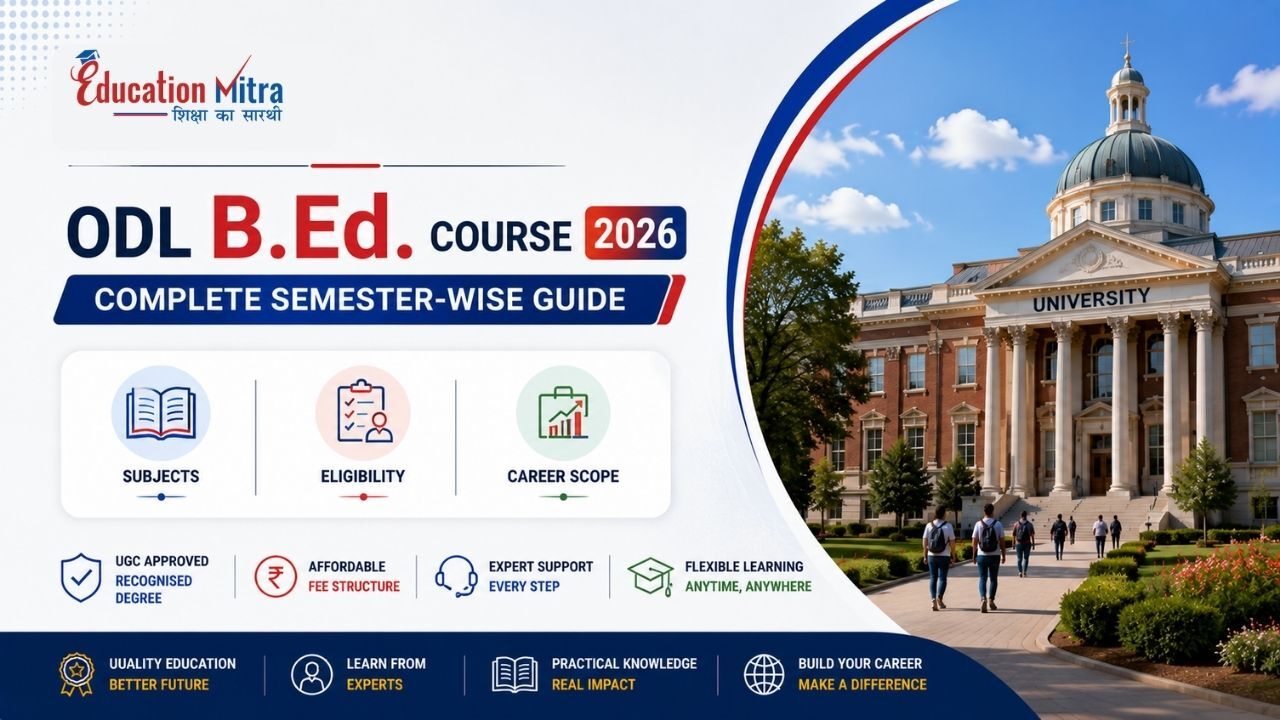
Discover the complete B.Ed syllabus for 2026 with semester-wise subjects, eligibility, course duration, fees, career opportunities, higher education o...
In shaping the future of society, teachers play a crucial role. Thus, many students who are enthusiastic about teaching choose this one of the most respected and rewarding professions. As the education sector continues to grow, the demand for skilled professionals is rising. Many working professionals, remote learners, career switchers, and housewives are actively choosing a Bachelor of Education (B.Ed) program through an open distance mode, which helps them acquire industry-oriented skills while balancing their personal and professional responsibilities.
A Bachelor of Education (B.Ed) is a professional degree program that can be pursued by any bachelor’s degree holder in a relevant subject from a UGC-approved university. A distance/online B.Ed course is designed for aspiring teachers, helping them to gain pedagogical knowledge, classroom management skills, educational psychology, curriculum planning, assessment techniques, and practical teaching experience required for teaching at the secondary and senior secondary levels.
Important: As per the NCTE (National Council of Teacher Education), the B.Ed course requires mandatory physical training, school internship, or teaching practice. Thus, the course is generally not offered through 100% online mode; ODL and Distance B.Ed programs that include hybrid learning as per the UGC and NCTE regulations are valid in India.
Unlike a conventional B.Ed course, the online and ODL B.Ed degree offers flexible learning through online classes, recorded sessions, digital learning materials, and on-campus training, making it an ideal choice for those who cannot commit to attending regular on-campus classes or follow a strict schedule.
In this comprehensive guide by Education Mitra, we'll explain the B.Ed. syllabus for 2026, including semester-wise subjects, eligibility, duration, programme structure, career opportunities, higher education options, and much more to help you make an informed decision.
Top Universities in India
Course Overview: Key Highlights
| Particular | Details |
|---|---|
| Course Name | Bachelor of Education (B.Ed) |
| Mode | ODL and Open Distance Mode (Hybrid Learning) |
| Course Level | Professional Undergraduate Programme |
| Duration | Minimum 2 Years; Maximum 4 Years |
| Number of Semesters | 4 Semesters (2 semesters each year) |
| Eligibility | Bachelor’s degree in any subject from a UGC-approved university or equivalent |
| Learning Support | Online Classes, Recorded Sessions, LMS Access, Digital Learning Material, On-Campus Training |
| Popular Focus Areas | Educational Psychology, Pedagogy, Curriculum Studies, Assessment, Educational Technology, Inclusive Education |
| Suitable For | Aspiring Teachers, Education Professionals & Teaching Career Aspirants |
What is an Online/Distance B.Ed. Course?
A Bachelor of Education (B.Ed) program is a 2-year undergraduate degree, especially designed for aspiring teachers who wish to build their career in the educational sector. This professional degree program is open to any bachelor’s degree holder seeking to develop foundational expertise, focusing on child psychology, teaching methodologies, and more, which helps them to explore a career in schools, EdTech, coaching institutes, and training centers.
With rapid growth in digitization, working professionals and remote learners can now opt for this dynamic program through online and distance learning modes. However, NCTE and UGC do not approve a 100% online B.Ed course; thus, there are several universities available that offer this professional degree program through ODL mode, ensuring hybrid learning.
The distance B.Ed course combines theoretical foundations of education with practical classroom experience. Students study educational philosophy, psychology, curriculum development, teaching-learning processes, educational technology, classroom management, inclusive education, assessment techniques, and subject-specific pedagogy.
B.Ed. Course Duration, Eligibility Criteria, and Average Fee Structure
Pursuing a Bachelor of Education (B.Ed) program is essential for those who wish to build their career in the education sector as a teacher, consultant, administrator, and other relevant fields. However, before making a choice, you must know about the course duration, eligibility, and fee structure to make an informed decision.
B.Ed Course Duration
The Bachelor of Education (B.Ed.) is generally a 2-year professional programme divided into four semesters. The curriculum is designed to progressively develop students' understanding of educational theories, teaching methodologies, curriculum planning, classroom practices, and professional teaching competencies.
B.Ed Course Eligibility
Although admission requirements may vary slightly among universities, the general eligibility criteria include:
- A Bachelor's Degree or Master's Degree from a recognized university.
- Candidates must obtain the minimum qualifying marks prescribed by the respective university and applicable NCTE guidelines.
- Admission may be based on a university entrance examination, state-level entrance test, or merit, depending on the institution.
- Candidates should always verify the latest eligibility requirements before applying.
| Course Name | Average Fee Structure (Per Annum) |
|---|---|
| ODL or Distance B.Ed Program | INR 20,000-30,000* |
If you have any queries regarding the course eligibility, duration, and more, connect with industry experts and choose wisely.
An Online/Distance B.Ed. Semester-Wise Syllabus Breakdown
The B.Ed. curriculum is designed to develop professional teaching competencies through a balanced combination of educational theory, pedagogical training, classroom practice, and school internships. Although individual universities may have slight variations in subject names, the overall curriculum prescribed by NCTE remains broadly similar across institutions.
Year 1: Foundations of Teaching & Learning (Semester 1 & Semester 2)
| Semester 1 | Semester 2 |
|---|---|
| Childhood and Growing Up | Sociological Foundations of Education |
| Philosophical Foundations of Education | ICT-Based Learning & Teaching |
| Contemporary India and Education | Reading and Reflecting on the Texts |
| Psychology of Learner and Learning | Teaching & Learning |
| Language Across the Curriculum | School Management |
| Pedagogy of School Subjects | Pedagogy of School Subjects |
| Workshop/Internship | Workshop/Activities |
Year 2: Professional Teaching Practice & School Internship (Semester 3 & Semester 4)
| Semester 3 | Semester 4 |
|---|---|
| Assessment for Learning | Contemporary issues in Education |
| Knowledge and Curriculum | Adolescence and Family Education |
| ICT Competencies | Environmental Education |
| Creating an Inclusive School | Information and Communication Technology |
| Art in Education | Health and Physical Education |
| Gender, School and Society | Drama and Art in Education |
| Workshop/Activities | Workshop/Internship |
How to Prepare for B.Ed. Semester Exams
Success in a B.Ed. programme requires balancing theoretical understanding with practical teaching skills. Students should focus on educational theories, teaching methodologies, child development, and classroom applications rather than memorizing concepts.
Effective Preparation Tips for B.Ed. Students
- Prepare a weekly study timetable or daily learning schedule and follow it consistently.
- Must attend all live classes, discussion forums, and teaching demonstrations.
- Read NCF, NEP, and educational policy documents for conceptual clarity.
- Watch recorded sessions multiple times to have clarity.
- Complete assignments and presentations on time and submit them.
- Solve previous year’s question papers and take mock tests.
- Strengthen communication and classroom management skills.
- Complete assignments, practicum records, and reflective journals on time.
Career Opportunities After Completing a B.Ed.
A B.Ed. degree opens the door to diverse teaching and education-related careers in both the public and private sectors. After completing the programme and fulfilling the applicable eligibility requirements (such as qualifying teacher eligibility tests where required), graduates can pursue teaching positions in schools, educational institutions, coaching organizations, NGOs, and education technology companies.
The B.Ed graduates are eligible for government jobs and can prepare for competitive exams, focusing on SSC, UPSC, IPS, KVS, DVSSS, and more.
| Job Role | Average Starting Salary* |
|---|---|
| Primary School Teacher | ₹2.5–5 LPA |
| Trained Graduate Teacher (TGT) | ₹3.5–6 LPA |
| Post Graduate Teacher (PGT)** | ₹4–7 LPA |
| Special Educator | ₹3.5–6 LPA |
| Academic Coordinator | ₹4–7 LPA |
| Education Counsellor | ₹3–6 LPA |
| Curriculum Developer | ₹4–8 LPA |
| Instructional Designer | ₹5–9 LPA |
| Academic Content Writer | ₹3.5–7 LPA |
| Education Consultant | ₹4–8 LPA |
What are the Higher Education Options Available After an ODL B.Ed. Course?
A B.Ed. not only prepares graduates for teaching careers but also provides a pathway to advanced studies in education, research, educational leadership, and specialized teaching disciplines.
- Master of Education (M.Ed.)
- M.A. in Education
- M.A. in Educational Psychology
- Master of Business Administration
Top Recruiters Hiring B.Ed. Graduates
A Bachelor of Education (B.Ed.) equips aspiring teachers with the pedagogical knowledge, practical teaching experience, and professional competencies required across various educational institutions.
- Kendriya Vidyalaya Sangathan (KVS)
- Navodaya Vidyalaya Samiti (NVS)
- State Government Schools
- CBSE & ICSE Affiliated Schools
- Delhi Public School (DPS)
- Ryan International School
- DAV Public Schools
- Podar Education Network
- GD Goenka Schools
- Amity International Schools
- BYJU'S
Final Thoughts
A Bachelor of Education (B.Ed.) is the gateway to a professional career in teaching and one of the most important qualifications for individuals who wish to contribute to the education sector. The programme combines educational theory, pedagogy, classroom practice, and school internships to prepare future teachers for the dynamic needs of modern education.
Before taking admission, students should carefully evaluate NCTE recognition, university affiliation, curriculum, faculty expertise, internship opportunities, placement support, and institutional reputation to ensure they receive quality teacher education.
If you're planning to pursue a B.Ed. programme in 2026, Education Mitra can help you compare recognized institutions, understand the admission process, and choose the right college based on your academic goals and career aspirations.
Need Expert Guidance?
Book a free 1-on-1 counselling session with our expert.


Find Your Perfect University
Answer a few questions & let our AI suggest the best universities for you.
University Match
Frequently Asked Questions
Have any Doubts? Let's Clear Out
How many semesters are there in a B.Ed. programme?
A B.Ed. is generally a 2-year professional degree programme divided into four semesters, although the academic structure may vary slightly among universities.
Can I do an online B.Ed course in India?
Does a B.Ed. programme include teaching practice?
Can I apply for government teaching jobs after completing a B.Ed.?
What are the career opportunities after completing a B.Ed.?
Latest Programs
Top Recommended Programs


Latest Blogs
You Might Also Like
Take the First Step Towards Your Dream Career
Connect with our education experts today to discover the best university, compare programs, and begin a smooth admission journey with complete guidance and personalized support..
- Choose Your Mentor
- Instant Expert Guidance

- Education Mitra
- >
- News
- >
- B.Ed. Syllabus and Subjects Explained: Complete Semester-Wise Guide (2026)