How the Viksit Bharat Shiksha Adhishthan Bill Will Replace UGC, AICTE & NCTE
 Aditya Sonker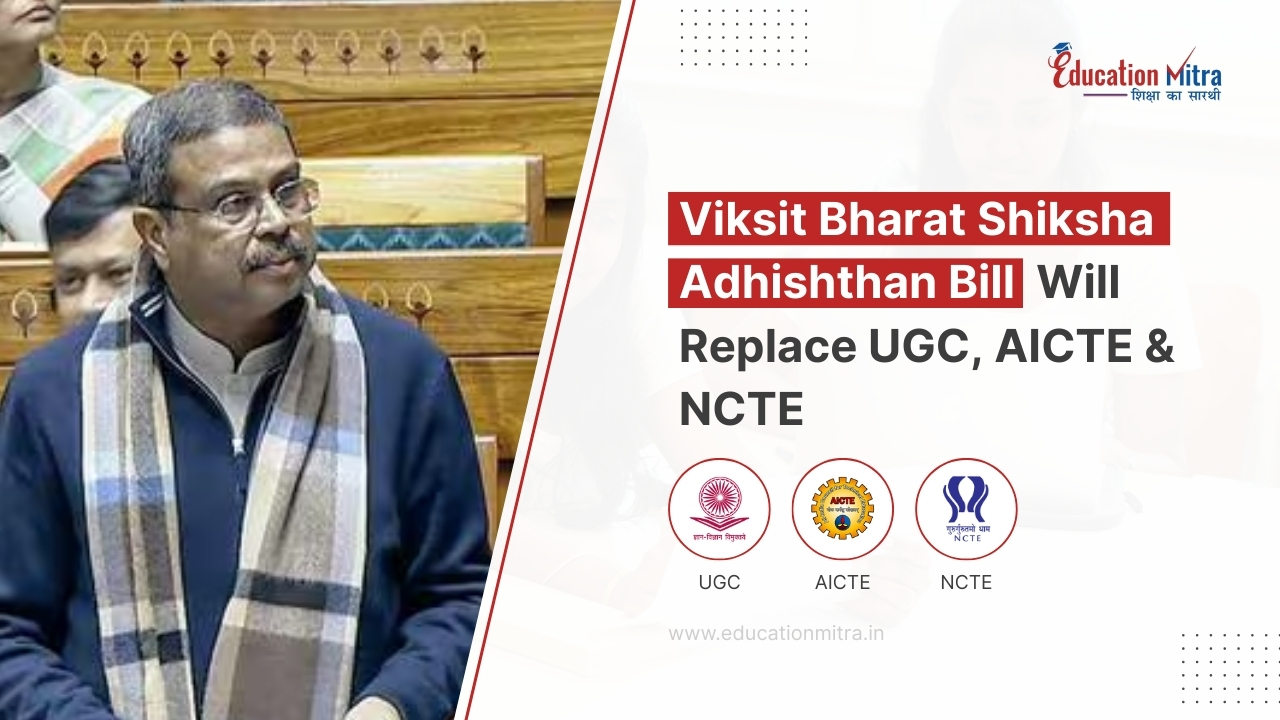
VBSA Bill 2025 aims to replace UGC, AICTE, and NCTE with a single higher-education regulator, aligning India’s education system with NEP 2020 reforms....

The Indian higher education landscape stands on the brink of one of its most transformative reforms in decades with the introduction of the Viksit Bharat Shiksha Adhishthan (VBSA) Bill, 2025. On Monday, the Union Education Minister ‘Dharmendra Pradhan’ proposed the VBSA bill in Lok Sabha to overhaul existing regulatory bodies, such as University Grants Commissions (UGC), All India Council for Technical Education (AICTE), and National Council of Teacher Education (NCTE).
The purpose is to consolidate them into a single body, aligned with the National Education Policy (NEP) 2020’s vision for a streamlined, transparent, and efficient system that promotes quality, autonomy, and global standards. The body named VBSA will set standards, coordinate policies, and support institutions, aiming to provide more freedom to universities while balancing quality education and accreditation.
Top Universities in India
What Is the Viksit Bharat Shiksha Adhishthan Bill, 2025?
The Viksit Bharat Shiksha Adhishthan Bill is a single regulatory body designed to reform the Indian Higher Education System, empowering universities by providing them with more freedom while maintaining course quality and accreditation. It replaces the other regulatory bodies, such as the University Grants Commission (UGC), All India Council for Technical Education (AICTE), and National Council of Teacher Education (NCTE).
As per the Bill proposed, it will have a 12-member commission divided into 3 wings: Accreditation Council, Standard Council, and Regulatory Council. There will be a head for all three councils that includes 2 senior professors, five experts, a Union Higher Education Secretary, and a member secretary. The appointments of all the members will be made by the Central Government.
Also Read: UGC Calls for Faculty Proposals to Develop MOOC on PM Gati Shakti
Role and Responsibilities of The Councils
Accreditation Council - Through a common quality framework, the Accreditation Council is responsible for assessing and rating the educational institutions, including Universities and colleges. By utilising technologies and online tools, the agencies monitor performance, make accreditation outcomes, and recommend penalties for violations. The purpose is to ensure that the education institute is accredited with reliable certificates and approvals.
Standard Council - By setting up learning outcomes, framing guidelines, and proposing penalties for violation, the Standard Council will define an academic quality benchmark. They are also responsible for designing curriculum, pedagogy, promoting Indian languages & knowledge system, and recommending qualifications for the faculty.
Regulatory Council – It is created to oversee compliance and transparency, ensuring the institute works under prescribed rules and regulations. They will check finances, courses, audits, faculty, and academic outcomes. They can take necessary action against financial or administrative irregularities, addressing student grievances.
Why Viksit Bharat Shiksha Adhishthan Bill, 2025, important?
Since the past several years, the Indian Higher Education System has operated under a fragmented regulated regime, which includes multiple bodies, such as UGC, AICTE, and NCTE, resulting in:
- Overlapping mandates and bureaucratic complexity
- Delayed approvals and compliance hurdles
- Inconsistent standards across disciplines and institutions
- Focus on inputs (infrastructure) over learning outcomes and research excellence.
Recognizing these limitations, the NEP 2020 recommended a unified regulator to rationalize the system - and the VBSA Bill is the legislative expression of this vision.
How VBSA Replace UGC, AICTE, and NCTE
Once implemented, the Bill will repeal the UGC Act, 1956, AICTE Act, 1987, and NCTE Act, 1993, dissolving existing bodies while their rules will remain until new regulations are established. During the transition, Clause 54 states the central government will appoint interim leadership for up to two years or until new bodies are formed.
Penalties Prescribed in The Bill for The Violations of Rules
As per the Bill, the Regulatory Bodies have the power to impose graded penalties.
- If the institute failed to take necessary action on the first violation, the minimum fine is ₹10 lakh.
- The second violation leads to a fine of ₹30 lakh, along with the responsible official or stoppage of grants.
- The repetition of violation costs a fine of ₹75 lakh or more, may suspension of the degree or closure of the institute.
- A fine of 2 crores is prescribed in the bill for setting up a college or university without government approval.
Conclusion
The Viksit Bharat Shiksha Adhishthan Bill, 2025, represents a bold attempt to reshape India’s higher education regulatory architecture. With the goals of simplifying compliance, elevating quality standards, and aligning with the NEP 2020 vision, it holds the promise of a more unified, efficient system.
Need Expert Guidance?
Book a free 1-on-1 counselling session with our expert.


Find Your Perfect University
Answer a few questions & let our AI suggest the best universities for you.
University Match
Latest Programs
Top Recommended Programs


Latest Blogs
You Might Also Like
Take the First Step Towards Your Dream Career
Connect with our education experts today to discover the best university, compare programs, and begin a smooth admission journey with complete guidance and personalized support..
- Choose Your Mentor
- Instant Expert Guidance

- Education Mitra
- >
- News
- >
- How the Viksit Bharat Shiksha Adhishthan Bill Will Replace UGC, AICTE & NCTE